How to build mobile apps that Indian SMEs can bet their business on
The Hook
Every week, another 'promising' app disappears from the Play Store. Not because the founders ran out of money — because they built something nobody wanted to use. The gap between a technically finished app and a successful app isn't luck. It's following the right process.
If you're an Indian SME looking to go mobile in 2026, here's how the best teams are building apps that stick.
1. Validate Before You Build
Most failed apps share one root cause: they were built for a user who didn't exist.
Best practice: Before writing a single line of code, talk to 10 real potential users. Not friends. Not family. Actual target users. Find out:
- What they currently do to solve the problem
- What they'd trade to make it better
- Whether they'd actually pay for a solution
The 2026 edge: Use AI-powered survey tools to analyze feedback at scale. But nothing beats direct conversations — do both.
An app that nobody downloads is still a failure, no matter how clean the code is.
2. Choose the Right Architecture From Day One
Bad architecture is a debt you pay forever. For 2026, the winning approach is:
Cloud-Native, Not Cloud-Ready
Don't just 'host it in the cloud.' Build for cloud scalability from the ground up:
- Use microservices so individual features can be updated without rebuilding the whole app
- Implement auto-scaling so your app handles a 10x traffic spike without crashing
- Choose managed services (AWS, Firebase) over DIY server management
Offline-First Thinking
Indian users — especially outside Tier 1 cities — still face spotty connectivity. Apps that demand constant internet access lose users fast.
Best practice: Build core functionality to work offline. Sync when connected. Your users shouldn't notice the difference.
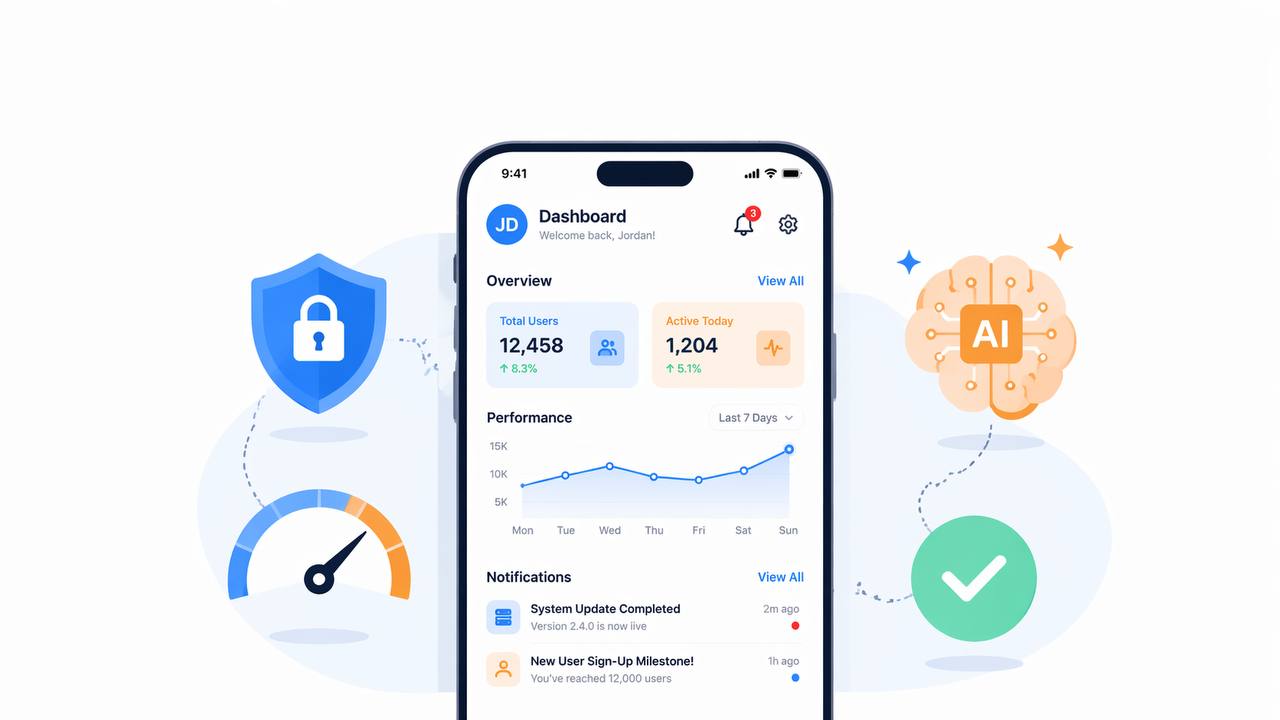
3. Security Isn't Optional — It's the Feature
With privacy regulations tightening globally and Indian users becoming more security-aware, a security-first approach is now a competitive advantage.
Non-negotiables for 2026:
- End-to-end encryption for any user data
- Biometric authentication (Face ID / fingerprint) as default, not premium
- Regular penetration testing (at least quarterly for apps handling payments or personal data)
- Compliance with DPDP Act requirements for Indian users
If your app handles payments or personal data and gets hacked, it's not just a tech problem — it's a business-ending problem.
4. Performance Is User Experience
Users will forgive a clunky UI. They will not forgive a slow app.
The numbers:
- 53% of mobile users abandon apps that take more than 3 seconds to load
- Every 1-second delay in page load can reduce conversions by 7%
2026 performance checklist:
- Optimize images for mobile (WebP format, lazy loading)
- Minimize API calls — batch requests, cache aggressively
- Use edge computing for latency-sensitive features (especially relevant for users across India)
- Profile on low-end devices, not just your development phone
5. AI Integration: Baseline, Not Bonus
In 2026, 'AI-powered' isn't a differentiator anymore — it's the expected baseline. Users assume apps have intelligent features.
Practical AI integrations that actually add value:
- Personalized recommendations based on user behavior
- Smart search that handles typos and natural language
- Predictive analytics for user needs (e.g., 'You usually order by Friday — want to reorder?')
- Automated support that actually solves problems (not just bot deflection)
Warning: Don't add AI for AI's sake. Every AI feature should solve a real user problem.
6. Accessibility Isn't Just Good Ethics — It's Good Business
India has 27+ million people with disabilities. An inaccessible app excludes a massive potential user base and opens you to legal risk under the Rights of Persons with Disabilities Act.
Basic accessibility every app needs:
- Screen reader compatibility
- Minimum 4.5:1 color contrast ratio
- Touch targets at least 48x48dp
- Captions and transcripts for any audio/video content
- No reliance on color alone to convey information
7. Test Like Your Business Depends On It — Because It Does
The best teams in 2026 are shipping smaller increments, faster, but not at the cost of quality.
Testing pyramid:
- Unit tests — every function does what it should
- Integration tests — modules talk to each other correctly
- UI/UX tests — real user flows work end-to-end
- Device testing — it works on the devices your users actually have
Pro tip: Build a 'dogfooding' process where your team uses the app internally for 2 weeks before any public release.
8. Plan for Growth (Even If You're Starting Small)
The apps that survive aren't the ones that plan for scale from day one — they're the ones that don't prevent scale.
Architectural choices that don't box you in:
- Use scalable cloud infrastructure from the start (even if usage is low)
- Design your database schema with growth in mind
- Implement monitoring and analytics from day one
- Keep code modular so new team members can contribute without creating spaghetti
Conclusion
Good app development in 2026 isn't about using the trendiest framework or the latest AI model. It's about:
- Building for a real user problem you've actually validated
- Creating a secure, performant experience that works on any device
- Integrating AI where it helps, not where it shows off
- Testing relentlessly and listening to real feedback
- Planning architecture that grows with your business
The apps that succeed are the ones that feel invisible — they just work, they solve problems, and they respect the user's time, data, and intelligence.
Ready to build something that actually works? Talk to Mejona — we specialize in building digital products for Indian SMEs that perform in the real world.
Read the article.
Now ship it.
30 minutes with our Patna & Bangalore engineering team. We'll audit what you have, scope what you need, and send you a written proposal — even if you don't hire us.